What is Stress Echo with Dobutamine?
Stress Echo with Dobutamine is a specialized cardiac examination that uses a medication (Dobutamine) to induce cardiac stress, simulating exercise conditions.
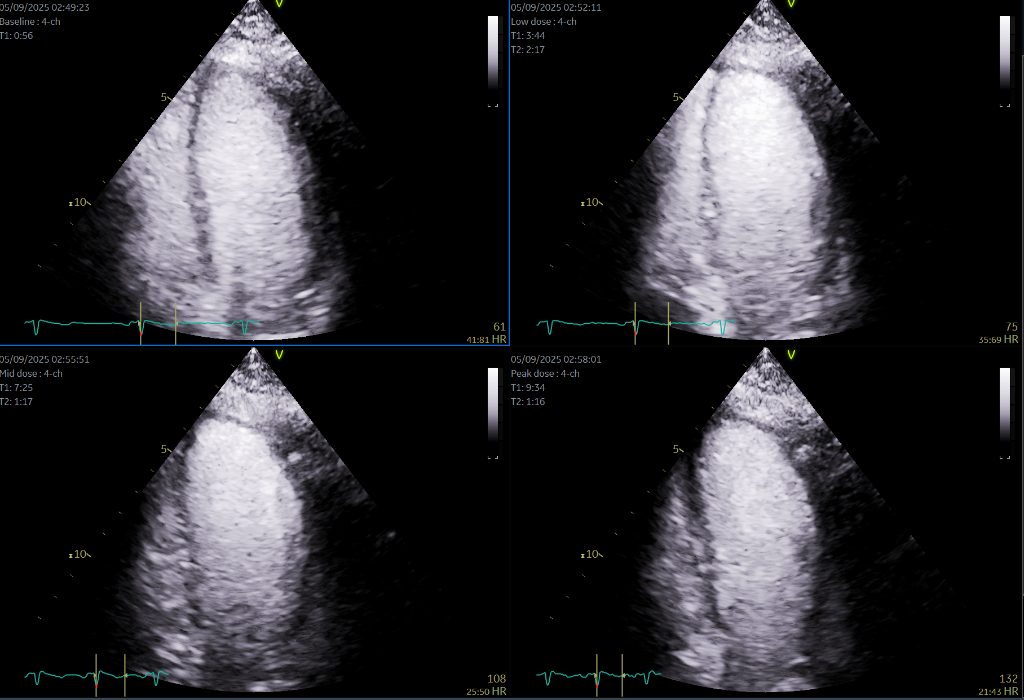
During the examination, we monitor with echocardiography how your heart responds as the heart rate increases during pharmacological stress.
This allows us to detect:
- Coronary disease (coronary artery stenosis)
- Ischemia (oxygen deficiency in myocardium)
- Myocardial viability after heart attack
- Valve disease assessment under stress
Why Dobutamine instead of exercise?
Pharmacological stress testing is suitable for patients who cannot achieve adequate physical exercise, for example because of orthopaedic or respiratory problems, or when a more accurate assessment of specific cases is required.
Stress Echo with GE Vivid E95: Enhanced Diagnostic Accuracy
Stress Echo at our clinic is performed with the GE Vivid E95, one of the leading cardiac ultrasound systems. This is critically important: during pharmacological stress the heart beats very fast and high image quality supports reliable assessment of wall motion at high heart rates. The cSound technology of the Vivid E95 ensures excellent image quality even at high heart rates, while the use of contrast agents further improves endocardial border resolution.
The comparison of images at rest and at peak stress is performed with parallel display of the images in real time. D. Boukis, with EACVI specialisation in cardiac imaging, immediately identifies new wall motion abnormalities — the hallmark sign of ischemia.
Compared to a standard exercise stress test, Stress Echo offers significantly higher diagnostic reliability: sensitivity ~85% vs ~68% and specificity ~85% vs ~77%. It directly detects wall motion abnormalities — the true sign of ischemia — rather than relying solely on indirect ECG changes that may be falsely positive. This is particularly important in women, patients with resting ECG changes, and cases where exercise ECG interpretation is uncertain. The full results and the written report are delivered on the same day.
When is Stress Echo recommended?
How is the Stress Echo examination performed?
Preparation
ECG electrodes and a venous catheter are placed for Dobutamine administration. First heart ultrasound at rest (baseline).
Dobutamine Administration
Dobutamine is administered in gradually increasing doses, usually every 3 minutes. Continuous ECG, blood pressure, and symptom monitoring.
Image Acquisition under Stress
At peak stress, echocardiographic images are taken for comparison with rest.
Recovery & Evaluation
Monitoring until return to normal heart rate. Immediate results analysis.
Duration
Total 60-90 minutes (includes preparation, examination, recovery)
Safety
Safe examination with continuous monitoring and immediate antidote availability
Preparation for Stress Echo
Before the examination
- • 4-hour fasting
- • Avoid coffee/tea on examination day
- • Discuss your medications with the doctor
- • Bring previous tests (ECG, echo, angiographies)
Contraindications
- • Recent heart attack (<7 days)
- • Unstable angina
- • Severe arrhythmias
- • Uncontrolled hypertension
- • Acute myocarditis/pericarditis
Important:
Some medications (e.g., beta-blockers) may need to be discontinued 24-48 hours before. Do not discontinue any medication without medical advice.
Patient Information Sheet
Download the information sheet with detailed instructions for preparation and the Stress Echo procedure.
Download PDFStress Echo Advantages
Non-Invasive
No catheterization or angiography. Safe alternative.
No Radiation
No radiation exposure, ideal for repeated examinations.
High Accuracy
80-85% sensitivity for coronary disease detection.
Economical
Much lower cost than angiography or CCTA.
Immediate Results
Written report the same day.
Multiple Information
Assessment of ischemia, function, valves and viability.