
What is Exercise Test?
The exercise test is an examination in which the patient walks on a treadmill with gradually increasing speed and incline, while ECG, blood pressure and symptoms are continuously monitored.
Physiological stress with exercise
Ischemia and arrhythmia detection
Endurance and exercise capacity measurement
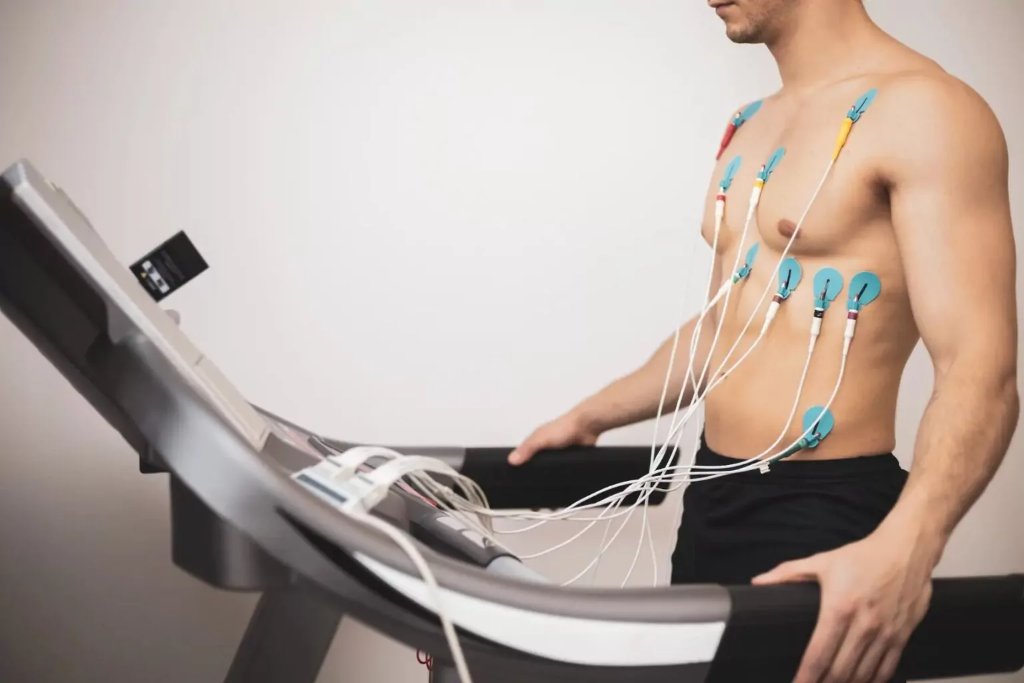
Equipment & Clinical Significance
The exercise test is performed using the Bruce or modified Bruce protocol (for elderly or patients with limited mobility). The professional medical treadmill with a 12-lead ECG digital recording system in real time allows detailed monitoring at every stage of the test.
The clinical significance is decisive: ischaemia that does not manifest at rest is revealed during physical exertion through typical ST-T changes on the ECG. Exercise-induced arrhythmias are also detected — a significant cause of sudden cardiac death. For patients after a heart attack or stent placement, the test assesses recovery and defines safe limits for physical activity.
Throughout the examination you are under direct medical supervision. D. Boukis evaluates the ECG, blood pressure, heart rate and symptoms in real time, and the test is stopped immediately if any abnormality appears. It is an extremely safe examination conducted under continuous medical supervision.
When is Exercise Test needed?
Angina Investigation
Chest pain during exercise
Coronary Disease Detection
Ischemia check
Endurance Assessment
Physical fitness measurement
Therapy Check
Treatment effectiveness
After Heart Attack
Prognosis estimation
Preoperative Assessment
Check before surgery
How is the Test conducted?
1. Preparation
ECG electrodes are placed and initial blood pressure is measured.
2. Exercise
The patient walks on the treadmill with gradually increasing speed and incline until target is reached or symptoms appear.
3. Recovery
After the test, the patient is monitored for 5-10 minutes during recovery.
Duration
20-30 minutes