
What is CT Coronary Angiography (CCTA)?
CT Coronary Angiography (CCTA) is an advanced imaging examination that uses a 128-slice CT scanner to create three-dimensional images of your coronary arteries.
It is the non-invasive alternative to invasive coronary angiography, providing detailed imaging without catheterization.
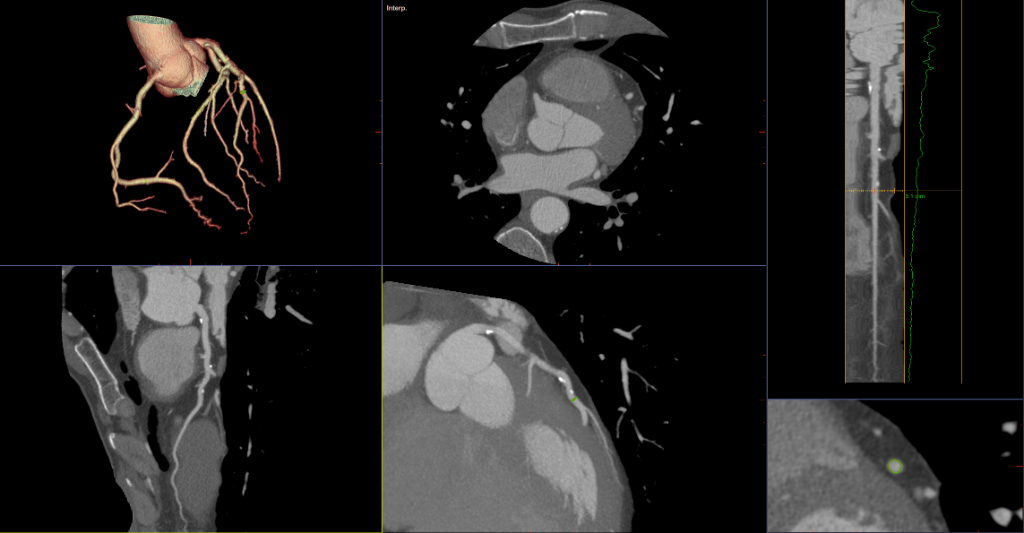
What does CCTA show?
- • Coronary artery anatomy
- • Stenosis and occlusions
- • Atherosclerotic plaque (hard/soft)
- • Calcification (Calcium Score)
- • Anatomical abnormalities
Advantages over Angiography
- • Non-invasive (no catheter)
- • No hospitalization
- • Faster (10-15 minutes)
- • Fewer complications
- • Lower cost
GE Revolution Maxima 128: The Technology Changing Diagnosis
CT Coronary Angiography is performed in collaboration with the Elpis General Clinic in Volos, using the GE Revolution Maxima 128-slice CT scanner — one of the most advanced CT systems worldwide. SnapshotFreeze 2.0 technology provides exceptionally detailed images of the coronary arteries even at high heart rates, without always requiring pharmacological heart rate reduction.
The 128-slice CT coronary angiography achieves spatial resolution <0.5mm, sufficient to detect even small atherosclerotic plaques that have not yet caused haemodynamically significant stenosis. This is critical: the "unstable" soft plaque is what causes heart attacks, long before it significantly occludes the vessel. The ability to analyse plaque composition (hard/soft/mixed) provides information that no other non-invasive examination can offer.
D. Boukis personally analyses every CCTA, combining the imaging information with the patient's clinical data for a comprehensive assessment. A detailed written report is issued with 3D reconstructions, evaluation of each coronary artery segment, and specific therapeutic recommendations.
When is CT Coronary Angiography recommended?
How is the examination performed?
Preparation & Medications
Venous line is placed for contrast administration. Medications are given to slow heart rate (<60 bpm) if needed.
CT Scanner Positioning
You lie on the CT scanner table. ECG electrodes are placed for synchronization with heartbeats.
Image Acquisition
Contrast is administered through vein and high-resolution images are taken in seconds. You will be asked to hold your breath for 10-15 seconds.
Analysis & Report
Cardiologist analyzes three-dimensional images and creates detailed written report with findings and recommendations.
Duration
Examination takes 10-15 minutes. Total time with preparation: 30-45 minutes.
Immediate Return
You leave immediately after examination. You can drive and continue normally.
Preparation & Contraindications
Before examination
- • 4-hour fasting
- • Avoid coffee 24 hours before
- • Bring previous heart tests
- • Inform about contrast/iodine allergies
- • Inform if taking diabetes medications
- • Heart rate should ideally be <60 bpm
Contraindications
- • Pregnancy
- • Severe kidney failure (GFR <30)
- • Iodine contrast allergy
- • Untreated hyperthyroidism
- • Severe arrhythmias
- • Inability to cooperate/hold breath
⚠️ Important:
If you have diabetes and take metformin (Glucophage), temporary discontinuation may be necessary. Discuss with your doctor.
Patient Information Sheet
Download the information sheet with detailed instructions for preparation and the CT Coronary Angiography procedure.
Download PDFCalcium Score - Calcium Scoring
Calcium Score is a quick CT examination (without contrast) that measures calcification in coronary arteries - an indicator of atherosclerosis.
No calcification - very low risk
Mild calcification - low risk
Moderate calcification - moderate risk
Significant calcification - high risk
💡 When to get Calcium Score?
Recommended for 40-75 year olds with intermediate cardiovascular risk for better risk stratification and therapy guidance.
CCTA Advantages
Non-Invasive
No catheterization or incisions. Simple venous line.
Safe
Minimal complications. No hospitalization or recovery.
High Accuracy
95-99% sensitivity for excluding coronary disease.
3D Imaging
Three-dimensional coronary artery images.
Plaque Information
Plaque composition assessment (hard/soft/mixed).
Speed
Much faster than invasive coronary angiography.